
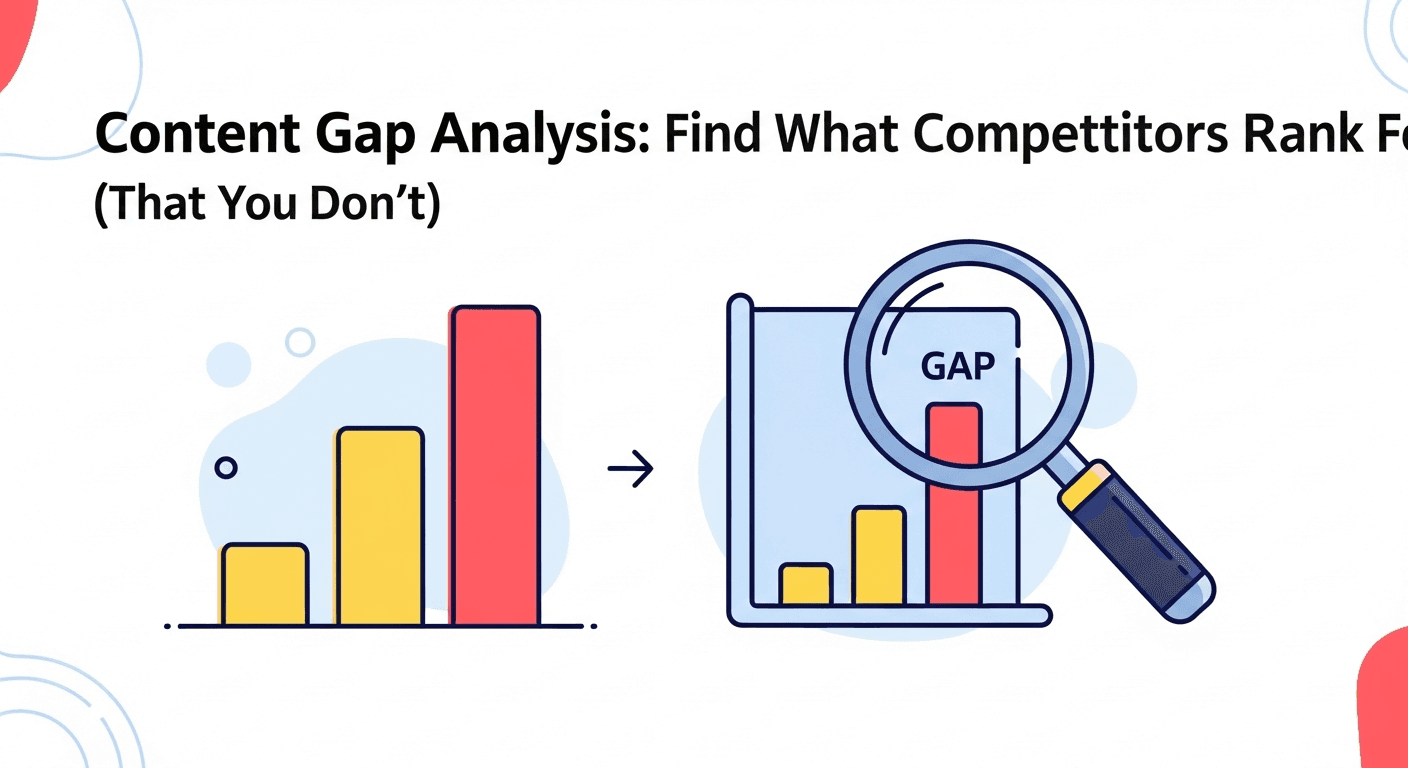
Here's a shortcut most small businesses miss: your competitors have already done a chunk of your keyword research for you. The topics they rank for — and you don't — are a ready-made list of what to write next.
- Content gap analysis identifies competitor keywords you don't rank for.
- It's a high-leverage SEO exercise, replacing guesswork with evidence.
- Focus on direct competitors, not just industry giants.
- Filter for relevant, winnable keywords; group related gaps into articles.
- Perform content gap analysis every few months as rankings shift.
Finding that list is called a content gap analysis. It's one of the highest-leverage SEO exercises there is, because it replaces guessing with evidence. Here's how to do one without an expensive subscription.
What is a content gap analysis?
A content gap analysis compares the keywords (and topics) your competitors rank for against the ones you rank for, and surfaces the gap — the searches they're winning that you're absent from.
Each gap is an opportunity: a proven keyword (someone already ranks for it, so there's demand) where you currently get nothing. Fill the best ones with genuinely useful content and you start competing for traffic that's already flowing — to someone else.
Why it beats brainstorming from scratch
When you brainstorm content ideas alone, you're guessing what people search. A content gap analysis is grounded in reality:
- It's proven demand. If a competitor ranks and gets traffic, the searches exist.
- It's relevant by definition. A direct competitor's keywords are, almost always, your keywords too.
- It's prioritised for you. The biggest gaps with the lowest difficulty are the obvious first moves.
It turns "what should we write about?" — the question that stalls most content efforts — into a concrete, ordered list.
How to do a content gap analysis (the simple way)
1. Pick your real competitors
Not the biggest names in your industry — the sites that show up when you search your own keywords. Those are who you actually compete with in the SERPs. One or two is enough to start.
2. Find what they rank for
You need the keywords driving traffic to their pages. Doing this manually is tedious, so use a tool: our content gap analysis takes your domain plus one or two competitors and returns the top keywords they rank for that you don't — with AI-suggested article angles for each.
3. Filter for winnable, relevant gaps
Not every gap is worth filling. Skip keywords that are off-topic for your business or impossibly competitive. Keep the ones that are clearly relevant and realistic to rank for — usually more specific, lower-difficulty terms. (New to judging this? See our guide to keyword research for beginners.)
4. Map gaps to content
Group related gaps into single articles rather than one page per keyword. Each group becomes a content brief. Order them by opportunity — biggest, most winnable, most relevant first.
5. Write, publish, repeat
Work down the list at a steady cadence. A content gap analysis isn't a one-off — re-run it every few months as competitors publish new things and your own rankings shift.
A quick example
Say you run a local accounting firm. You rank for "bookkeeping services [city]" but a competitor also ranks for "how much does a bookkeeper cost," "bookkeeper vs accountant," and "do I need a bookkeeper as a sole trader." Those three are gaps — proven questions your potential clients ask, that you're invisible for. That's three articles, briefed in thirty seconds, each one a chance to catch a customer earlier in their decision.
Further reading
FAQ
What's the difference between a content gap and a keyword gap?
They're closely related. A keyword gap is specifically the search terms a competitor ranks for that you don't; a content gap is the broader topics or content types you're missing. In practice you find content gaps by analysing keyword gaps — the keywords reveal the topics.
How many competitors should I analyse?
One or two direct competitors is plenty to start — the ones that actually appear when you search your own keywords. Adding more gives diminishing returns and a longer list than you can realistically act on.
Can I do a content gap analysis for free?
Yes. A free content gap analysis tool will surface competitor keywords you're missing without a subscription. Paid SEO suites add depth, but you don't need one to get a strong first list.
How often should I run one?
Every few months, plus whenever a competitor clearly ramps up their content. Search demand and rankings shift, so a gap analysis is a recurring habit, not a one-time project.
Turn the gap into a plan
Run a content gap analysis on your site and one competitor, and you'll likely walk away with more good content ideas than you can act on this quarter. That's a good problem.
The next problem is actually writing all of it — consistently, in your voice. That's where AI SEO on autopilot comes in: analyze your website free and let BoltSEO turn those gaps into published articles. Three free, no credit card.
Keep reading
More on SEO, GEO and growing your organic traffic.

20 Best Blog Examples for 2026: Your Ultimate Guide
Explore 20 top blog examples for 2026, from B2B to lifestyle, and learn what makes them successful. Discover strategies to elevate your content with AI-powered SEO.
Read article
SEO Software for Agencies: Your 2026 Toolkit for Growth
Discover the best SEO software for agencies in 2026 to streamline operations, enhance client results, and scale your growth. Find tools for automation, reporting, and content creation.
Read article
Beyond Google: Exploring Search Engines for Your Business
Discover powerful search engines besides Google that offer unique features for privacy, niche searches, and AI-powered results.
Read articleReady to rank? Start free today.
Put your SEO on autopilot. No credit card, no installations — ready in 2 minutes.