
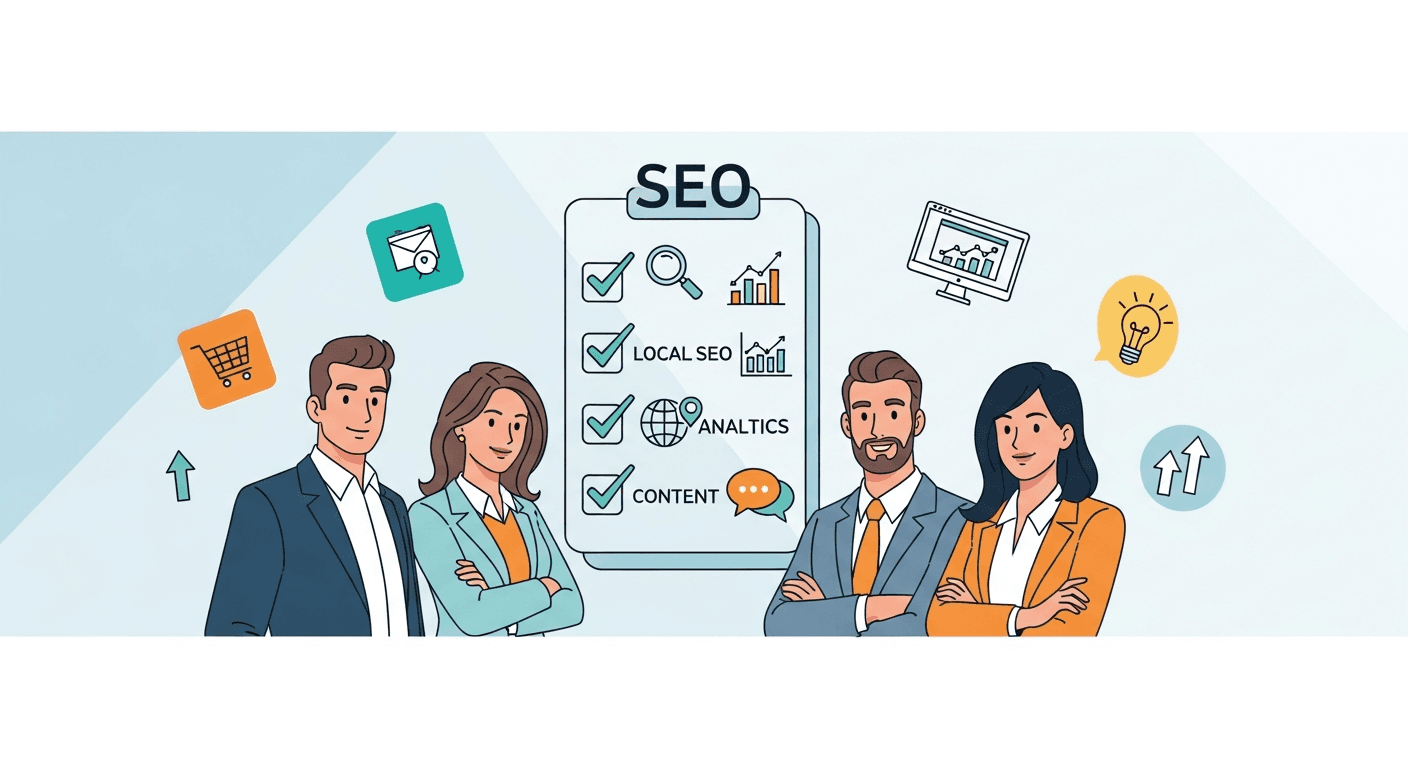
Most "SEO checklists" are written for SEO professionals. They list 87 things, half of which don't matter for a small business, and none of which tell you what to do first.
- Prioritize foundational SEO steps like site indexability and Google Search Console setup.
- Focus on keywords that customers actually search for and that are winnable for small businesses.
- Optimize on-page elements like title tags, meta descriptions, and headings for clarity and search intent.
- For local businesses, a complete and active Google Business Profile and consistent NAP are crucial.
- Consistently publish genuinely useful content that answers customer questions to drive long-term traffic.
This one is different. It's the checklist I'd hand a friend who runs a small business — a shop, a clinic, a trade, a one-person agency — and wants to rank on Google without hiring anyone. It's in priority order: the things at the top move the needle most. Do them in sequence and stop worrying about the rest until you have.
No jargon. Where a step needs a tool, I'll point you at a free one.
Before you start: the one rule that matters
Google's job is to answer a searcher's question with the most helpful result. That's it. Every item below is just a way of helping Google see that your business is the most helpful answer for the searches your customers actually make.
If you remember nothing else: be genuinely useful, then make it easy for Google to notice. The checklist is the "make it easy" part.
1. Foundations (do these first)
- Confirm Google can find your site. Search
site:yourdomain.comon Google. If nothing shows up, Google hasn't indexed you — the rest is moot until it does. - Set up Google Search Console. It's free, it's Google telling you directly how you appear in search, and it's the single most important tool you'll use. Submit your sitemap here.
- Make sure every important page is reachable in a click or two from your homepage. If a page is buried, Google treats it as unimportant.
- Check your site works on a phone. Most local searches happen on mobile. If it's clumsy on a phone, you'll lose rankings and customers.
Don't skip these for the "fun" stuff below. A beautiful keyword strategy on a site Google can't crawl is wasted effort.
2. Keywords: write about what people search
The most common small business SEO mistake is writing about what you find interesting instead of what customers type into Google.
- List the questions customers actually ask you. Those are keywords. ("How much does X cost?" "Do you do Y on weekends?")
- Find the winnable ones. Big generic terms ("plumber") are owned by big budgets. Specific terms ("emergency boiler repair Antwerp") are winnable and convert better.
- Check the data. Run your domain through the opportunity keywords finder — it returns keywords with search volume and difficulty so you're not guessing. (New to this? Start with our keyword research for beginners guide.)
- One main keyword per page. Don't try to rank one page for ten things. Give each important topic its own page.
3. On-page SEO: make each page obvious
"On-page" just means the things on the page itself that tell Google (and the reader) what it's about.
- Title tag — the clickable blue headline in Google. Put your main keyword near the front, keep it under ~60 characters, make it tempting.
- Meta description — the grey text under the title. It doesn't directly affect ranking, but a good one gets more clicks. Write it like an ad.
- One H1 per page that matches the search intent.
- Headings (H2/H3) that break the page into scannable chunks — for readers and for Google.
- Image alt text describing each image in plain words.
- Internal links — link your pages to each other with descriptive anchor text. This is free and underused.
Not sure how a page is doing on these? A free SEO audit scores your page 0–100 and lists the highest-impact fixes first.
4. Local SEO (if you serve a place)
If customers come to you, or you go to them, this section is your highest-leverage work. Local SEO is how you show up in the map pack and "near me" searches.
- Claim and complete your Google Business Profile. This is the big one. Categories, hours, photos, services — fill in everything.
- Keep your NAP consistent — Name, Address, Phone — identical everywhere it appears online. Inconsistency confuses Google.
- Get reviews, and reply to them. Reviews are a major local ranking factor and the thing customers read first. Ask happy customers; respond to all of them.
- Add LocalBusiness schema to your site so Google can read your address, hours, and area served as structured data. Our schema markup generator builds copy-paste-ready LocalBusiness markup for free.
- Create a page per location or service area if you serve several — each one a chance to rank locally.
5. Content: the engine that compounds
Foundations and on-page get you eligible to rank. Content is what actually pulls in traffic month after month — and it's where most small businesses quietly give up.
- Answer one customer question per article, properly. Depth beats word count.
- Publish consistently. One genuinely useful article a week beats ten in a burst and then silence. SEO compounds; consistency is the strategy.
- Link new articles to your service pages and tools with keyword anchor text, so the authority you build flows to the pages that make you money.
- Refresh old content when it goes stale. Updating a post often beats writing a new one.
This is the part AI changed most. Writing useful, optimized content used to be the bottleneck for small businesses; it no longer has to be — which is the whole reason we built AI SEO on autopilot.
6. Technical basics (don't over-think these)
You don't need to be a developer. Just don't trip over the basics:
- Speed — a slow site loses rankings and visitors. Compress images; that fixes 80% of speed problems.
- HTTPS — the padlock. Non-negotiable in 2026.
- A sitemap submitted to Search Console.
- No accidental "noindex" on pages you want found (a surprisingly common own-goal).
7. Measure, then repeat
- Watch Search Console monthly: which queries show your site, your average position, your click-through rate.
- Track a handful of target keywords, not a hundred. Are they moving up?
- Double down on what works. When a page starts ranking, add related content around it.
How much should you do yourself?
| DIY this checklist | Hire an agency | AI SEO on autopilot | |
|---|---|---|---|
| Cost | €0 + your time | €800–€2,500/mo | €0 to a low subscription |
| Time from you | High | Low | ~15 min/week |
| Best for | Learners with time | Funded businesses | Owners who want results without the grind |
| The content step | Slowest part | Outsourced | Automated in your brand voice |
Honestly? Do sections 1–4 yourself this month — they're mostly one-time setup and nobody knows your business better than you. Then decide whether the ongoing content engine (section 5) is something you keep up manually or automate.
Further reading
FAQ
How long does SEO take to work for a small business?
Usually three to six months to see meaningful movement, longer for competitive terms. Local SEO (your Google Business Profile, reviews) can show results in weeks. SEO compounds — the work you do now pays off for years, which is exactly why starting beats waiting.
Can a small business really compete with big companies on Google?
Yes — by being specific. You won't outrank a national chain for a generic term, but you can absolutely win specific, local, and long-tail searches where the big players are too broad to be the most helpful answer. That's where small businesses win.
Do I need to pay for SEO tools?
Not to start. Google Search Console is free, and you can do keyword research, an SEO audit, and schema markup with free tools. Paid tools help once you scale, but they're not the barrier to getting started.
What's the single most important SEO step for a local business?
Your Google Business Profile. For any business customers visit or that serves a local area, a complete, active profile with reviews is the highest-leverage thing you can do — often more impactful than your website itself.
Is AI content okay for small business SEO?
Yes, as long as it's genuinely helpful. Google ranks useful content regardless of how it's made and penalizes low-effort spam — which was true long before AI. We cover this in depth in does Google rank AI content?.
Start with one thing today
You don't have to do all of this at once — that's how people freeze and do nothing. Pick the top unchecked box and do it today. Set up Search Console. Claim your Google Business Profile. Run a free SEO audit and fix the first thing it flags.
And if the content engine in section 5 is the part you know you'll never keep up with by hand, that's exactly what BoltSEO automates. Analyze your website free — three articles, no credit card — and watch it find your keywords and write your first one in about two minutes.
Small businesses can absolutely win at SEO in 2026. It just takes the right steps, in the right order, done consistently.
Keep reading
More on SEO, GEO and growing your organic traffic.

20 Best Blog Examples for 2026: Your Ultimate Guide
Explore 20 top blog examples for 2026, from B2B to lifestyle, and learn what makes them successful. Discover strategies to elevate your content with AI-powered SEO.
Read article
SEO Software for Agencies: Your 2026 Toolkit for Growth
Discover the best SEO software for agencies in 2026 to streamline operations, enhance client results, and scale your growth. Find tools for automation, reporting, and content creation.
Read article
Beyond Google: Exploring Search Engines for Your Business
Discover powerful search engines besides Google that offer unique features for privacy, niche searches, and AI-powered results.
Read articleReady to rank? Start free today.
Put your SEO on autopilot. No credit card, no installations — ready in 2 minutes.