
Blog·Advertising
AI Ad Copy That Converts: The 2026 Framework for Small Businesses
The exact ad copy framework small businesses use to turn AI-generated drafts into Facebook and Google ads that convert — with six proven formulas, character limits, and three tests every ad must pass.
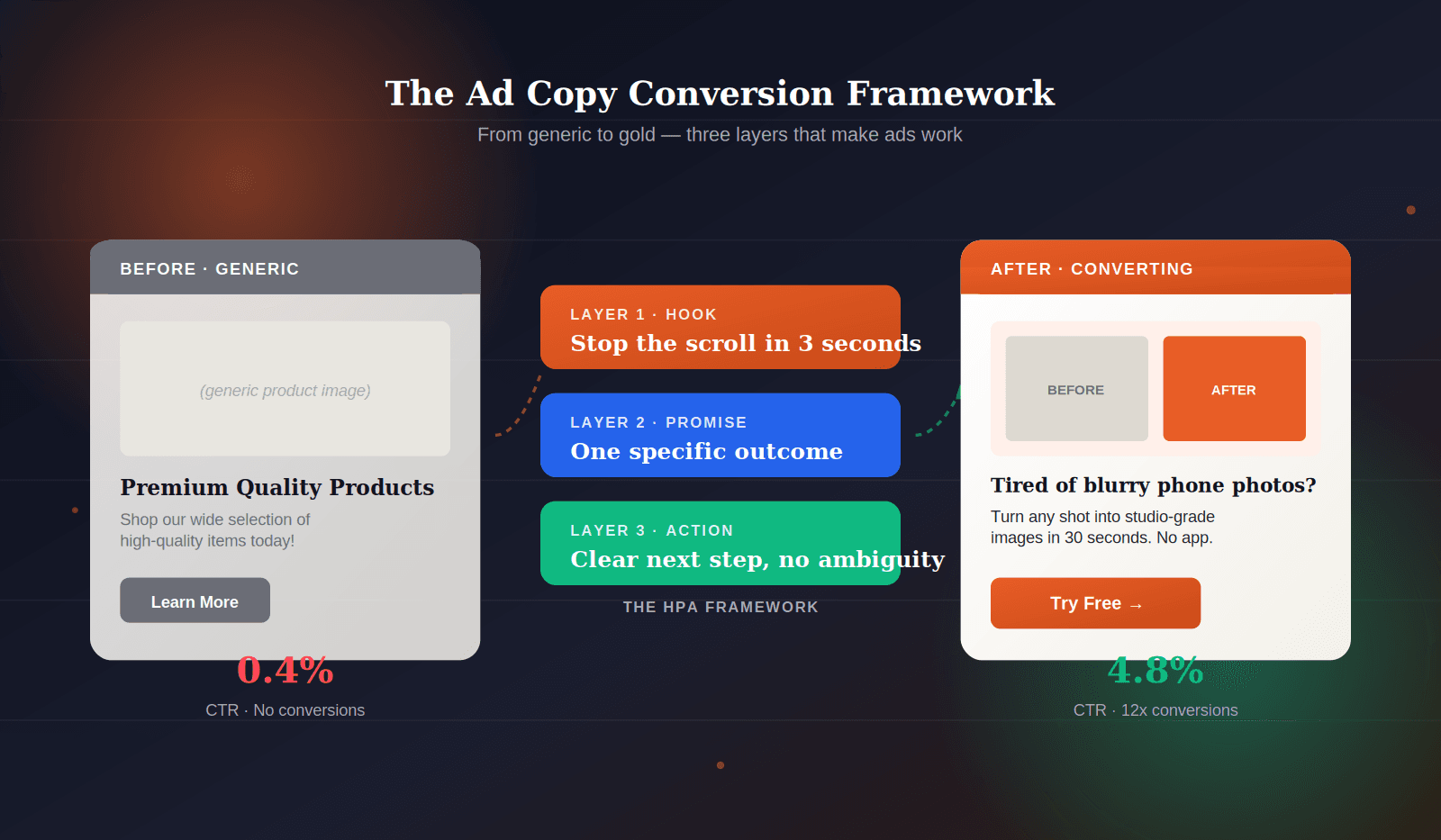
Most small business ads fail at the same moment: the first three seconds. A thumb scrolls past, a click never happens, and another €20 of ad budget disappears into the algorithm with nothing to show for it.
The problem usually isn't targeting, and it isn't budget. It's the words. Generic headlines, vague promises, and lazy calls to action kill ad performance faster than anything else — and they're the one thing you have complete control over.
This guide gives you a repeatable framework for writing (or prompting AI to generate) ad copy that earns clicks and converts them into customers. You'll get the three-layer structure every high-performing ad shares, six proven copywriting formulas matched to specific use cases, platform-specific character limits for Facebook and Google Ads, and a three-test checklist to run before you spend a single euro on a campaign.
No theory. No fluff. Just the patterns that work in 2026.
Table of Contents
- Why Most Small Business Ad Copy Fails
- The HPA Framework: Hook, Promise, Action
- Six Ad Copy Formulas That Convert
- Platform-Specific Rules: Facebook vs. Google Ads
- How to Prompt AI for Ad Copy That Actually Works
- The Three Tests Every Ad Must Pass
- Ad Copy Examples: Before and After
- Frequently Asked Questions
Why Most Small Business Ad Copy Fails
Before we get to what works, it helps to understand why so many small business ads don't. The pattern is remarkably consistent — and fixable.
Most failing ads share three flaws. First, they describe the product instead of speaking to the customer. "Premium quality products at unbeatable prices" tells the reader nothing they care about. Second, the value proposition is generic enough to apply to any competitor. Swap the logo and the ad still works for a different business, which means it doesn't really work for yours. Third, there's no specific action to take. "Learn more" is a default, not a decision.
The business impact is significant. The average Facebook Ads conversion rate across industries sits around 8-9% in 2026, but the gap between top-performing ads and bottom-performing ads is enormous — losing ads can convert at under 1%, while well-crafted ads in the same category routinely hit 12% or higher. That's a 12x difference in efficiency, driven almost entirely by copy and creative.
The ad itself is the conversion engine. If the copy is generic or the offer is forgettable, no amount of targeting can save it.
For a small business spending €300 a month on ads, the difference between weak and strong copy is roughly the difference between losing money every week and building a reliable customer acquisition channel. That's not a rounding error — that's whether your marketing works.
The HPA Framework: Hook, Promise, Action
Every ad that converts does three things in a specific order: it stops the scroll, makes a promise, and asks for a clear action. We'll call this the HPA framework — Hook, Promise, Action — and it's the spine underneath every formula we'll discuss below.
Layer 1: The Hook (first 3 seconds)
The hook exists for one reason: to earn the next two seconds of attention. That's it. It doesn't need to explain your product, list your features, or close the sale. It needs to make the reader think "wait, this is about me."
The strongest hooks pattern-match to something the reader already thinks or feels. A florist's hook might be "Forgot it was your anniversary again?" A bookkeeper's hook might be "Opening your tax folder in April shouldn't feel like this." These work because they're specific, emotionally charged, and instantly recognizable to the right audience.
Weak hooks describe the business ("Welcome to our shop"). Strong hooks describe the reader's current state ("Still stuck on Q3 receipts?"). The difference is everything.
Layer 2: The Promise (seconds 3-8)
Once you have attention, you need to earn the click. That means making one specific promise about what the reader will get and how they'll get it. Not three promises — one. Specificity always beats quantity here.
Compare these two promises for the same product:
- "High-quality, professional photo editing for your small business"
- "Turn any phone photo into studio-grade product images in 30 seconds"
The second one wins because every word does work. "Turn any phone photo" acknowledges the starting point. "Studio-grade" sets the quality bar. "In 30 seconds" quantifies the effort. The reader can actually picture what they'll get.
Layer 3: The Action (the final ask)
The final layer is the call to action — and this is where most small business ads quietly fail. Generic CTAs like "Learn More" or "Click Here" underperform specific ones by significant margins because they ask the reader to make a vague commitment.
Specific CTAs name the action and its value: "Get the free template," "Check pricing," "See before & after photos," "Claim your first-order discount." Each one tells the reader exactly what happens next and why they should care.
A simple test: if your CTA could be used unchanged on a competitor's ad, it's too generic. Rewrite it.
Six Ad Copy Formulas That Convert
The HPA framework is the structure. Formulas are the shortcuts — battle-tested patterns that give you a reliable starting point for any ad. The six below cover roughly 90% of what small businesses need to write.
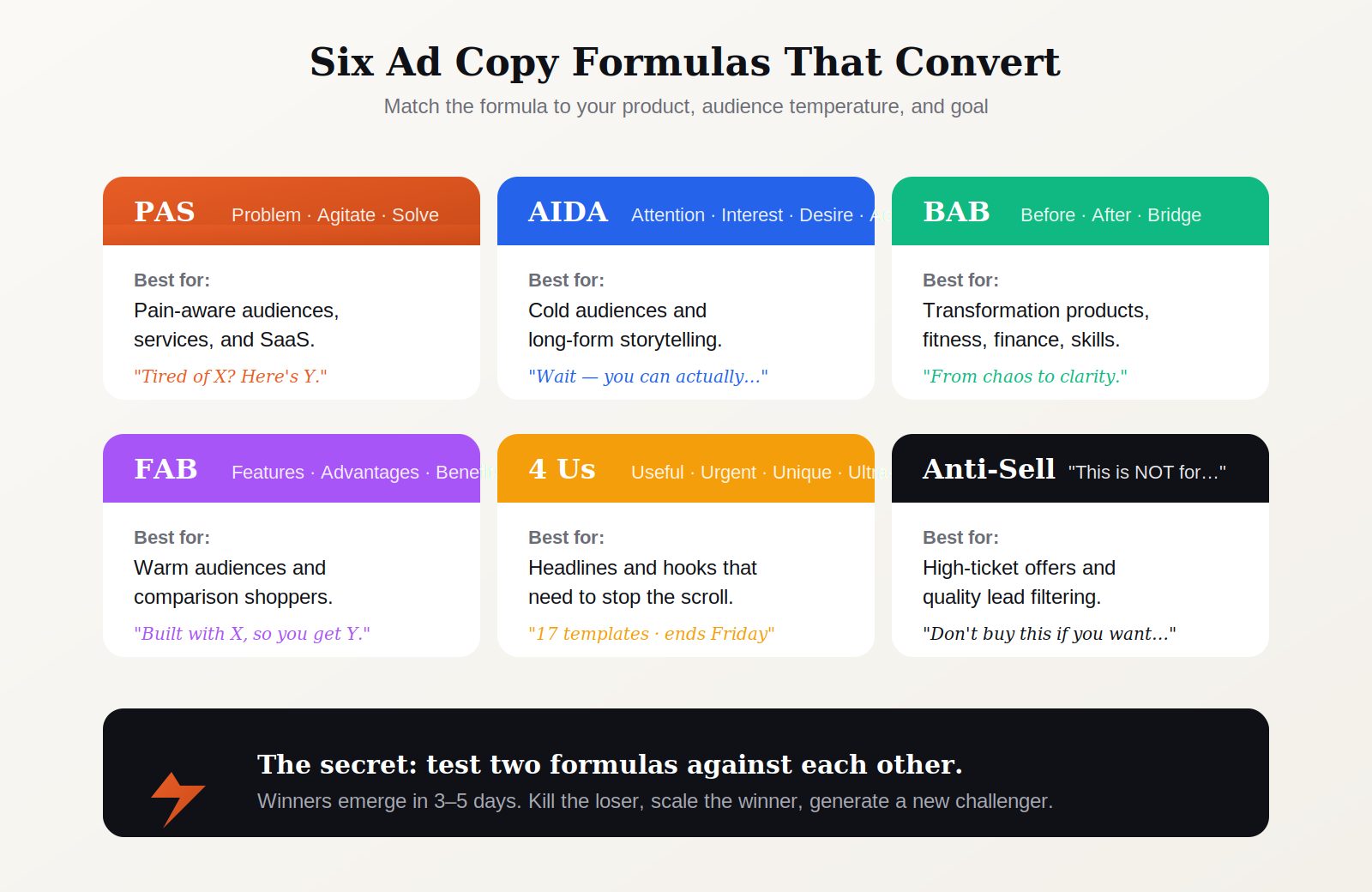 The six formulas — match the formula to your product type, audience temperature, and campaign goal.
1. PAS — Problem, Agitate, Solve
The workhorse of direct-response advertising. State the problem. Agitate it by describing what it feels like to live with it. Present your solution.
Example (service business):
"Your bookkeeping is three months behind. Every receipt you touch feels like another decision you don't have time to make. We handle small-business books in 48 hours — no spreadsheet required."
PAS works because it mirrors how humans actually process buying decisions: we feel the pain before we consider the fix. It's especially strong for pain-aware markets like accounting, legal services, and SaaS.
2. AIDA — Attention, Interest, Desire, Action
The oldest formula in advertising, and still one of the most reliable. Grab attention, build interest with a relevant fact or benefit, create desire through specificity or proof, then ask for action.
AIDA is best for cold audiences who don't yet know they have the problem you solve. It gives you room to educate before you sell, which matters when the reader isn't primed to buy.
3. BAB — Before, After, Bridge
Show where the reader is now, paint a picture of where they could be, then position your product as the bridge between the two states.
Example (fitness):
"Before: 30 minutes of cardio, zero energy, no results. After: 20-minute sessions, twice the strength, visible change in 6 weeks. Bridge: the workout protocol that actually works for busy people."
BAB is the go-to formula for any transformation-oriented product: fitness, finance, skill development, productivity tools.
4. FAB — Features, Advantages, Benefits
Start with a feature. Explain the advantage that feature creates. Translate the advantage into a concrete benefit for the reader.
Example (product business):
"Our espresso machine has dual-boiler technology (feature). That means no wait time between steaming milk and pulling shots (advantage). You get café-quality drinks at home in under 90 seconds (benefit)."
FAB works best with warm audiences and comparison shoppers — people who already know they want the category and are figuring out which product to buy.
5. The 4 Us — Useful, Urgent, Unique, Ultra-Specific
A headline formula rather than a full ad structure. Every strong headline should hit at least three of these four criteria. Useful to the reader. Urgent enough to act on. Unique enough to stand out from competitors. Ultra-specific rather than vague.
Weak: "Download our marketing guide" Strong: "17 Facebook ad templates used by 6-figure shops (free until Sunday)"
The second headline hits all four: useful (templates), urgent (Sunday deadline), unique (specific user type), and ultra-specific (17, 6-figure).
6. The Anti-Sell — "This is NOT for…"
A counterintuitive but highly effective approach for high-ticket offers and quality lead filtering. Open by telling people who the offer isn't for.
Example:
"This is NOT for business owners looking for a quick fix. If you want someone to rewrite your website in a week, we're not your team. If you want a 90-day brand overhaul that changes how your market sees you, let's talk."
The anti-sell works because it signals confidence, filters out unqualified prospects before they waste your sales time, and makes the reader feel the offer is exclusive rather than desperate.
Platform-Specific Rules: Facebook vs. Google Ads
Great copy isn't enough if it doesn't fit the platform. Facebook and Google have different character limits, different user intents, and different conventions — and ignoring them costs you ad performance.
Facebook and Instagram (Meta) Ad Copy Specs
Meta ads have three text fields, each with its own sweet spot:
- Primary text: 125 characters recommended before the "See More" cutoff on mobile. Front-load your hook — anything past 125 characters may never be read.
- Headline: 27-40 characters depending on placement. Facebook Feed recommends 27; Reels Overlay drops to 10.
- Description: 25 characters, but this field only displays in select placements (Marketplace, Search Results, In-Stream Video). Never put critical information here.
Meta users are in social mode, not search mode. They didn't come looking for your product — you interrupted their scroll. This means your copy should feel native to the platform: conversational, visual-first, emotionally resonant. Corporate language dies on Meta.
A practical rule for Meta: if your ad copy could appear unchanged in a magazine, it's wrong for the feed. Rewrite it as something your target customer's friend might actually say.
Google Ads Responsive Search Ads (RSA) Specs
Google ads live in a different universe. Searchers already know what they want — they typed it. Your job is to match their intent with maximum relevance in very little space:
- Headlines: 30 characters each, up to 15 per ad (minimum 3). Google rotates combinations.
- Descriptions: 90 characters each, up to 4 per ad.
- Display URL path: 15 characters each, up to 2 paths.
Google's own recommendation: provide at least 10-15 unique headlines so the algorithm has room to optimize. Include your primary keyword in 2-3 headlines. Write headlines that make sense independently — Google may show any combination, so none can rely on another.
Critical Google Ads rules that catch small businesses off guard: no emojis (they'll reject your ad), no ALL CAPS except for recognized abbreviations like "USA" or "FAQ," and no repeated punctuation. Spaces count toward the character limit.
The fastest way to improve Google Ads CTR is usually not better copy — it's better keyword-to-headline alignment. If someone searches "plumber near me" and your headline says "Quality Home Services," you're losing the click before they even read the description. And while paid ads buy you the click today, the same keyword intent is what lets you rank on Google automatically over time — so the search terms you're bidding on are worth targeting organically too.
How to Prompt AI for Ad Copy That Actually Works
AI-generated ad copy has reached the point where it's genuinely useful for small businesses — but only if you prompt it correctly. Most people get bland output because they write bland prompts.
A strong AI ad copy prompt includes five elements:
1. Role and voice. Tell the AI who it is and how it should sound. "You are a direct-response copywriter for a local family bakery. The voice is warm, playful, and confident."
2. Product and audience. Be concrete. "We sell custom birthday cakes, starting at €45, to parents of kids aged 3-12 in the Benelux region." Vague inputs produce vague outputs.
3. The offer. State exactly what the ad is promoting and what the reader gets if they click. "10% off first orders placed 7+ days in advance."
4. The formula and framework. Explicitly name what you want. "Use the PAS framework. Primary text should be 125 characters max, headline 27 characters, description 25 characters."
5. The quantity and variation. Ask for multiple versions so you can test. "Generate 3 variations: one focused on parents short on time, one focused on avoiding a bakery disappointment, one focused on making the kid feel special."
A good prompt produces copy that's 80% ready to ship. You'll still need to edit — and you should — but you'll start with drafts that already understand your audience, product, and format constraints. The same structured-prompt discipline pays off on the landing page your ad points to: feeding the offer into an outline generator first gives the page a logical flow before you write a word, so the click you paid for doesn't bounce on arrival.
💡 Pro tip: Save the prompts that produce your best ads. Reuse them with small tweaks instead of rewriting from scratch. After 10-20 winning ads, you'll have a personal prompt library that consistently outperforms generic AI output.
The Three Tests Every Ad Must Pass
Before you spend money promoting any ad — AI-generated or otherwise — run it through these three tests. They take under two minutes combined and will save you significant budget.
Test 1: The Competitor Swap Test
Read your ad copy with your competitor's logo next to it. Does it still make sense? If yes, your copy is generic — it's not differentiating your business from anyone else in your category.
Strong ad copy fails the competitor swap test. It mentions something specific to your business that no competitor can honestly claim: your unique process, your location, your founding story, a quantified result, a named customer. If everything in your ad could truthfully come from a competitor, rewrite it until at least one sentence couldn't.
Test 2: The 3-Second Test
Cover everything in your ad below the first line of text. Can a reader who has never heard of your business understand, in three seconds, what you're offering and why it matters to them?
If they can't, your hook is too slow. Most ads fail this test because they open with a greeting ("Hi everyone!"), a brand statement ("At Maria's Bakery, we believe…"), or a feature ("Our new 5-tier cakes are…"). None of these earn the next three seconds. Open with the reader's problem, desire, or moment of recognition.
Test 3: The Specific Action Test
Read only your call to action. Does it tell the reader exactly what happens next and hint at why it's worth their time?
- "Learn More" ❌ — tells nothing, promises nothing
- "Get Free Samples" ✓ — specific action, concrete value
- "See Pricing" ✓ — specific action, implied commitment level
- "Book Your Free 15-Min Consultation" ✓ — maximally specific
Every weak CTA you fix typically improves click-through rate by 15-30% on its own, without touching the rest of the ad.
Ad Copy Examples: Before and After
Theory is one thing. Here's what it looks like in practice — three real small business scenarios, shown as weak copy versus rewritten copy using the frameworks above.
Example 1: Local Coffee Shop (Facebook Ad)
Before (generic, fails all three tests):
"Welcome to Corner Brew! We serve the best coffee in town. Come visit us today for a delicious cup and friendly service. Open 7 days a week!"
After (PAS formula, passes all three tests):
"Monday mornings aren't getting easier. But a flat white made with beans roasted 200m from your desk helps more than you'd think. First one's on us if you bring this ad in before Friday."
Headline: Fuel for awful Mondays CTA: Claim your free coffee →
The "after" version identifies a specific, universal problem (Monday mornings), makes a specific promise (local, fresh beans), and gives a specific, time-bound CTA.
Example 2: Accounting Service (Google Ads)
Before (generic RSA headlines):
"Professional Accounting Services | Quality Work at Fair Prices | Contact Us Today"
After (keyword-aligned RSA headlines with specificity):
H1: "Small Biz Bookkeeping — €99/mo" H2: "Caught Up in 48 Hours" H3: "Tax-Ready Books, Monthly" H4: "Benelux Accountants, Flat Rate" H5: "Free Cleanup on Your First Month"
D1: "We fix messy books in 2 days flat. €99/month, no hidden fees, no minimum commitment. Cancel anytime. Serving Benelux small businesses since 2019." D2: "Tired of tax-season panic? Monthly bookkeeping from €99. We handle everything, you get your evenings back. Free first-month cleanup."
The rewritten version includes the primary keyword ("bookkeeping"), a specific price, a specific timeframe, and two different emotional angles (cost savings vs. time savings) that Google can test against each other.
Example 3: Online Fitness Coach (Instagram Ad)
Before (feature-dump, no hook):
"New 12-week transformation program available! Includes workout plans, nutrition guides, and weekly check-ins. Sign up now at our website."
After (BAB formula, specific audience):
"6 weeks ago, Marta couldn't finish a single push-up. Last Tuesday she did 12 in a row. Not in a gym. Not with equipment. Just 20 minutes a day, 4 days a week, in her living room."
Headline: From 0 to 12 push-ups in 6 weeks CTA: See Marta's exact plan →
The rewritten version tells a specific story with named characters, quantified results, and a promise the reader can mentally test against their own life. It passes the 3-second test (the first line hooks immediately) and the specific action test (the CTA promises to deliver the exact thing the ad described).
Frequently Asked Questions
How many variations of ad copy should I test?
Start with 3 variations using different formulas (e.g., one PAS, one BAB, one 4 Us). Run each with equal budget for 3-5 days or until one clearly wins (typically 1,000+ impressions per variation). Kill the losers, keep the winner, and generate a new challenger using the same approach. This "test two, kill one" rhythm keeps your creative fresh and your costs dropping over time.
How long should my Facebook ad copy be?
Meta's own guidance is 1-3 lines for primary text — about 125 characters. Longer copy isn't wrong, but anything beyond 125 characters gets hidden behind the "See More" link on mobile, where most users will never expand it. Front-load your hook and promise in the first 125 characters; use the rest for social proof, detail, or urgency only.
What's the fastest way to improve ad copy conversion rate?
Fix your call to action first. Generic CTAs like "Learn More" routinely underperform specific CTAs ("Get the free guide," "See July pricing") by 15-30% with no other changes. It's the single highest-leverage edit you can make to any existing ad, and it takes under a minute per variation.
Should I use emojis in my ad copy?
On Facebook and Instagram, yes — emojis can increase engagement significantly when used sparingly (1-2 per ad, placed at natural break points). On Google Ads, no — emojis are prohibited and will cause your ad to be rejected automatically. For Google, use standard punctuation like asterisks, plus signs, or ampersands for visual emphasis instead.
Can AI really write ad copy that converts?
Yes, when prompted correctly. Modern AI tools produce ad copy that's 80% ready to ship if you give them a detailed prompt including role, voice, audience, offer, formula, and platform constraints. The remaining 20% is human editing — adjusting for brand voice, fact-checking, and adding the specific details (customer names, local references, proof points) that AI can't know. The businesses getting the most out of AI ad copy aren't the ones who ask AI to "write me an ad" — they're the ones who've built detailed prompts over time.
How do I know if my ad copy is working?
Track two metrics religiously: click-through rate (CTR) and cost per conversion. A "good" Facebook CTR in 2026 is 1-3% depending on industry; a "good" Google Ads CTR is 3-6% for search. More importantly, track what it costs you to acquire one paying customer. Copy improvements that drop your cost per conversion by even 20% compound dramatically over a year of ad spend — that's often the difference between marketing that pays for itself and marketing that doesn't.
What platforms should small businesses prioritize?
Start with the platform where your customers already spend time. For most B2C small businesses, that's Instagram or Facebook. For B2B services, it's usually LinkedIn or Google Ads. For local service businesses (plumbers, dentists, restaurants), Google Ads almost always wins because it captures high-intent searches ("plumber near me"). Don't try to be on every platform — be excellent on one before expanding.
Keep reading
More on SEO, GEO and growing your organic traffic.
AI Marketing Automation for Small Businesses: The Complete 2026 Guide
How business owners are using AI to generate a full week of social posts, ad copy, and emails in under a minute — and why you should too.
Read article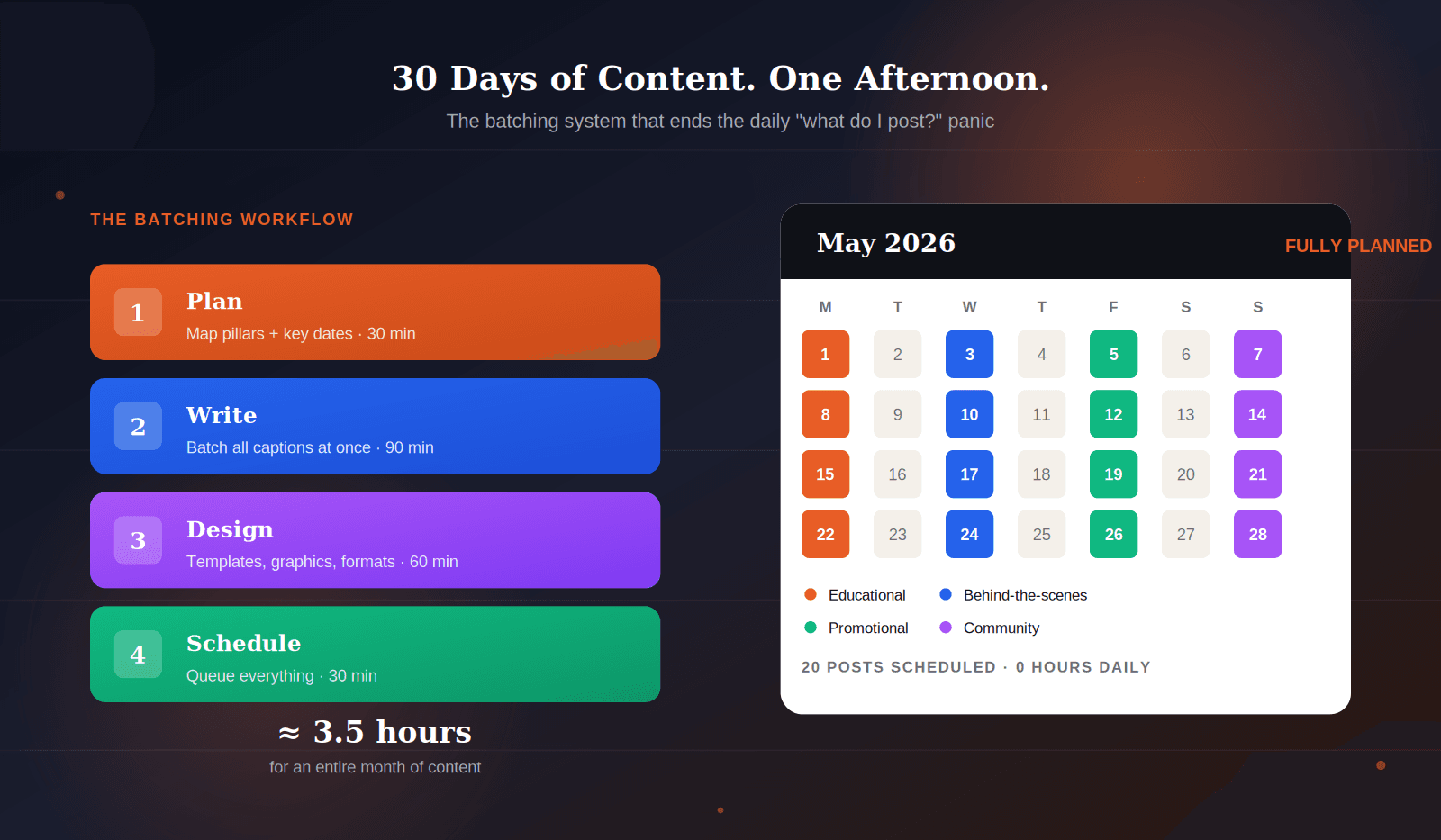
Social Media Content Calendar on Autopilot: 30 Days in 30 Minutes
How to generate, schedule, and batch a full month of on-brand posts across Instagram, Facebook, and LinkedIn in one sitting — with a repeatable weekly rhythm you can actually stick to.
Read article
Brand Voice for AI: How to Train Your Tone Without a Style Guide
Practical playbook for defining your brand's voice in plain language so AI tools generate content that sounds like you — not like a chatbot. Five tone archetypes and a 10-minute setup.
Read articleReady to rank? Start free today.
Put your SEO on autopilot. No credit card, no installations — ready in 2 minutes.