
Blog·Branding
Brand Voice for AI: How to Train Your Tone Without a Style Guide
A practical playbook for defining your brand's voice in plain language so AI tools generate content that sounds like you. Five tone archetypes, a 10-minute setup, and the prompt template that makes AI stop sounding like a chatbot.
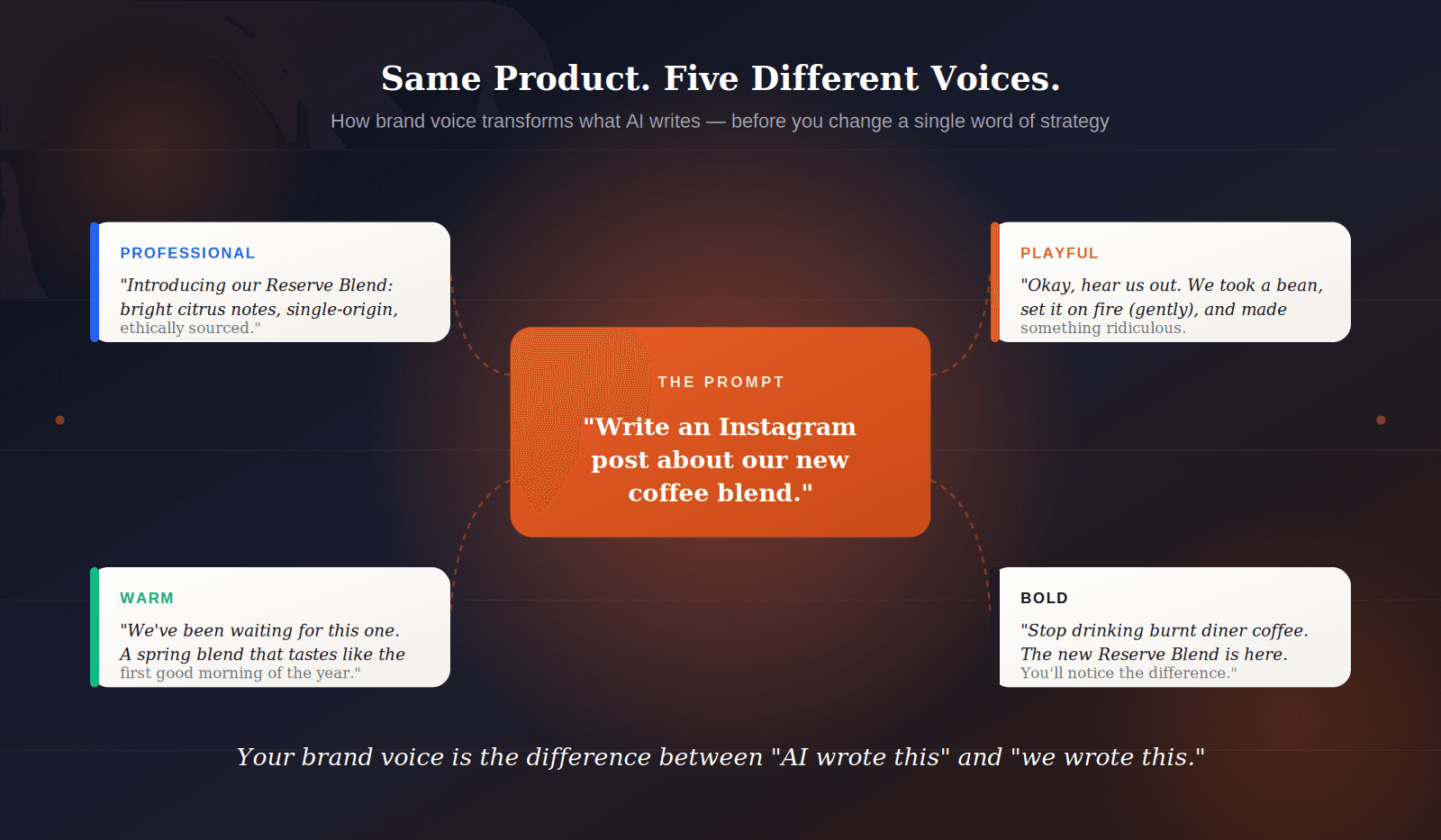
There's a reason AI-generated content is so easy to spot. It's not the grammar, the pacing, or the word choices in isolation. It's the absence of a distinct voice — the feeling that the text could have come from any business in any industry. Generic in, generic out.
The fix isn't a 40-page brand style guide. Most small businesses don't have one, don't need one, and would never actually use one if they wrote it. The fix is a clear, compact definition of your voice that you can hand to any AI tool — ChatGPT, Claude, a marketing platform — in under 200 words, and have it immediately produce content that sounds like your business instead of a chatbot.
This guide walks you through the exact process. You'll learn the five brand voice archetypes most small businesses fit into, a 10-minute setup that defines your voice without professional branding help, the one-paragraph prompt template that makes any AI tool match your tone, and the ongoing refinement habits that keep your voice consistent as your business grows.
No agency budget required. Just a clear system and an afternoon.
Table of Contents
- Why Brand Voice Matters More in the AI Era
- Voice vs. Tone: The Distinction That Matters
- The Five Brand Voice Archetypes
- The 10-Minute Brand Voice Setup
- The Universal AI Brand Voice Prompt
- How to Test if Your Voice Actually Works
- Keeping Your Voice Consistent Over Time
- Frequently Asked Questions
Why Brand Voice Matters More in the AI Era
There was a time when brand voice was a nice-to-have — something only agencies cared about and consumers rarely noticed. That's changed completely. When every business has access to the same AI writing tools, voice is often the only meaningful differentiator between your content and everyone else's.
Consider what happens without a defined voice. Your AI-generated Instagram captions sound like everyone else's AI-generated Instagram captions. Your email newsletter reads like it could have come from a competitor. Your ad copy pattern-matches to every other ad in the feed. You're spending time and money producing content that works against you — because generic content actively erodes the thing that makes customers choose you over alternatives.
The data backs this up. Research from brand consistency studies shows that a consistent brand voice correlates with significantly higher customer retention and roughly 33% higher revenue for brands that nail it. That's not a soft metric — that's the difference between a business that compounds and one that constantly has to re-acquire customers.
Consistent brand voice is a competitive edge. Use it to codify, scale, and protect your brand's tone across every channel.
In 2026, voice isn't just about sounding good. It's about being recognizable in a feed where every other business is using the same tools you are. The same principle applies to the blog content that helps you rank on Google automatically: a distinct voice is what keeps AI-assisted articles from reading like the interchangeable filler that fills every search result.
Voice vs. Tone: The Distinction That Matters
Before defining your voice, it helps to understand what voice actually is — and how it differs from tone. The two are often used interchangeably, but they're meaningfully different.
Voice is your brand's personality. It stays the same across every channel, every piece of content, every season. If your brand is warm and direct, it's warm and direct in customer service emails, in ad copy, in a crisis statement, and in a celebration post. Voice is your constant.
Tone is how you modulate that voice for context. The same brand speaks differently in a celebration post than in an apology. Different in a tutorial than in a sales pitch. Same voice, adjusted tone. You can be warm and direct and excited on launch day, warm and direct and apologetic when something goes wrong, warm and direct and serious during a crisis.
This distinction matters for AI content because it means you only need to define your voice once. Tone variations happen through prompt adjustments at the moment of writing, but the underlying voice — the thing that makes the output recognizably yours — stays constant.
For small businesses, this is good news. You don't need a 50-page document. You need a clear, compact voice definition that can flex into different tones when the moment calls for it.
The Five Brand Voice Archetypes
Most small businesses fit into one of five voice archetypes. Your actual voice probably borrows traits from two or three, but one will feel like home. Start there, then refine.
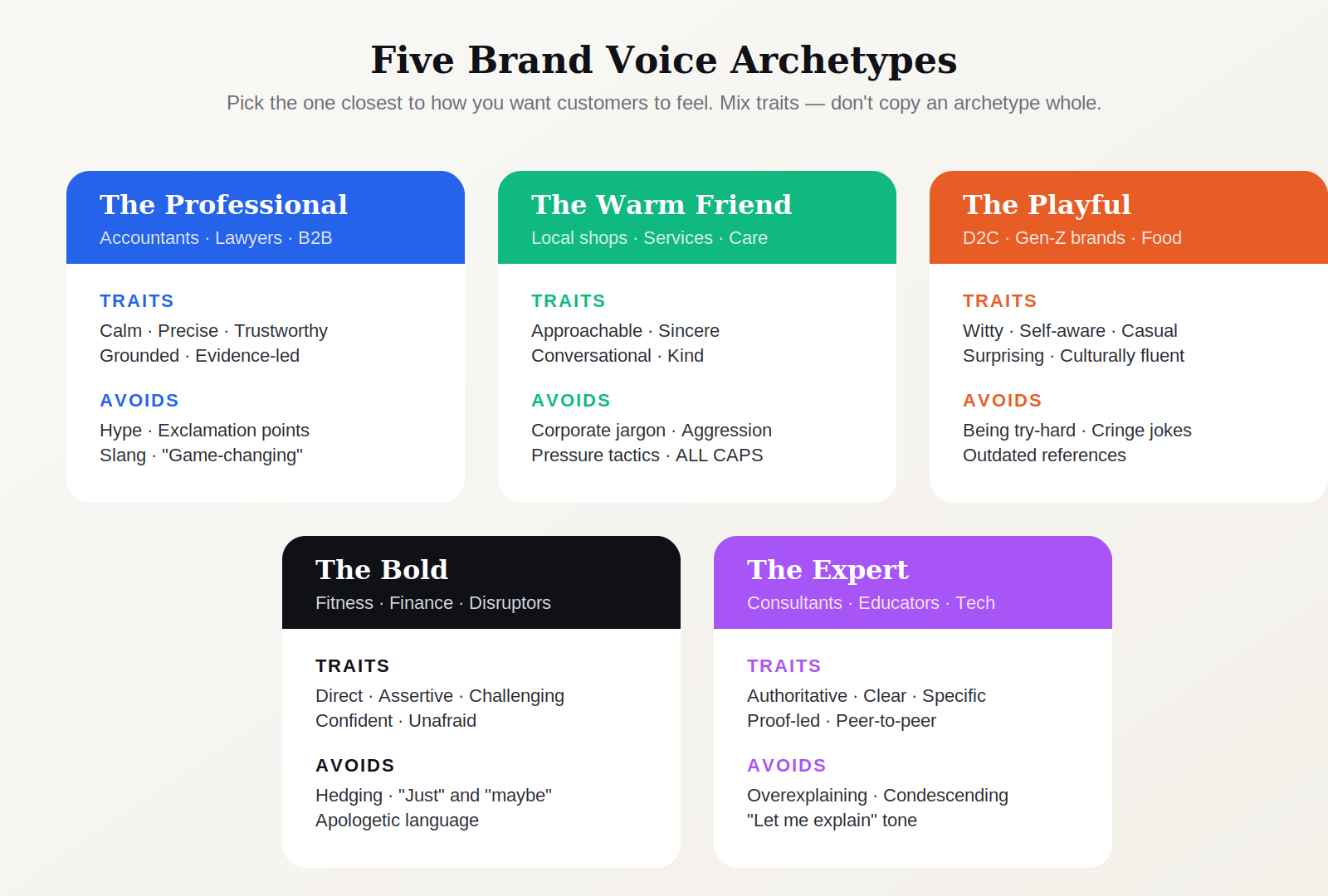 The five archetypes — pick the one closest to how you want customers to feel, then adapt the traits to fit your business.
The Professional. Calm, precise, trustworthy, grounded. Best for businesses where customers are making high-stakes decisions and need to feel confident — accountants, lawyers, financial advisors, B2B service providers, healthcare adjacent. Avoids hype, exclamation points, trendy slang, and anything that could undermine credibility.
The Warm Friend. Approachable, sincere, conversational, kind. Best for local businesses, service businesses, caregivers, wellness brands, and community-driven products. Avoids corporate jargon, aggressive sales language, pressure tactics, and ALL CAPS. Sounds like a real person talking to another real person.
The Playful. Witty, self-aware, casual, surprising. Best for direct-to-consumer brands, Gen-Z-focused products, food and drink businesses, and anything where entertainment value matters as much as information. Avoids trying too hard, cringe references, and jokes that don't land. When it works, it's highly shareable. When it doesn't, it's painful.
The Bold. Direct, assertive, confident, challenging. Best for fitness, finance, high-ticket services, disruptor brands, and any business whose value proposition depends on telling customers something they don't want to hear. Avoids hedging, apologetic language, and phrases like "just" and "maybe." Speaks with conviction.
The Expert. Authoritative, clear, specific, proof-led. Best for consultants, educators, SaaS and tech products, and any business selling expertise. Avoids overexplaining, condescension, and "let me explain" energy. Treats the reader as a peer capable of understanding sophisticated concepts if explained well.
Most businesses end up with a primary archetype (the dominant voice) and a secondary trait from another archetype that softens or sharpens it. A "warm friend" with "expert" undertones sounds different from a pure warm friend. A "playful" brand with "bold" undertones hits differently than pure playful. That's where your voice becomes specifically yours instead of a copy of an archetype.
The 10-Minute Brand Voice Setup
Here's the actual process for defining your voice — no agency, no style guide, no branding consultant required. Block 10 minutes and work through these four steps in order.
Step 1: Pick your primary archetype (2 minutes)
Read the five archetypes above and pick the one that feels most natural to how you'd actually want to talk to your best customers. Not the most impressive. Not the most "professional." The one that feels right. Gut response usually wins here.
Step 2: Identify one secondary trait (2 minutes)
Pick one trait from a different archetype that adds nuance. "Warm friend" + "expert clarity." "Playful" + "bold confidence." "Professional" + "warm accessibility." This combination is what makes your voice distinct rather than generic.
Step 3: List 3-5 words and 3-5 anti-words (3 minutes)
Words your brand uses: terms, phrases, or vocabulary that feel authentic. A bakery might list "fresh," "handmade," "warm," "morning." A software company might list "shipped," "built," "iteration," "real."
Words your brand avoids: terms you never want in your content. Common anti-word lists include "synergy," "game-changing," "revolutionary," "unlock," "leverage," "best-in-class." Your list will be specific to your industry — whatever makes you wince when competitors use it.
Step 4: Write 2 on-tone and 2 off-tone example sentences (3 minutes)
The fastest way to communicate voice to AI is through examples. Write two sentences that perfectly capture how your brand should sound. Then write two sentences that sound close but wrong — content that's technically correct but off-voice. The contrast teaches the AI what to do and what to avoid in ways that descriptions can't.
On-tone example (warm friend + expert):
"Your sourdough is probably underproofed. Give it two more hours at room temperature — that's the difference between a dense crumb and the open one you're chasing."
Off-tone example (same brand, but hype-y):
"🔥 UNLOCK the secret to PERFECT sourdough! Our revolutionary method will GAME-CHANGE your baking forever!"
Same information. Completely different voice. AI can learn the difference in seconds when you show it examples side by side.
After these four steps, you have everything you need: a dominant personality, a distinguishing secondary trait, preferred vocabulary, forbidden vocabulary, and real on-tone/off-tone examples. That's your brand voice, fully defined, in one page or less.
The Universal AI Brand Voice Prompt
Now the payoff. Here's the prompt template you plug your voice into to get AI writing in your voice from the first attempt. Paste this at the start of any session with ChatGPT, Claude, or any AI writing tool. Save it once, reuse it forever.
You are a copywriter for [BUSINESS NAME], a [INDUSTRY/CATEGORY]
serving [TARGET CUSTOMER].

Our brand voice is primarily [PRIMARY ARCHETYPE] with [SECONDARY TRAIT]
undertones.

We sound: [3-5 TRAIT WORDS]
We avoid sounding: [3-5 ANTI-TRAIT WORDS]

Vocabulary we use: [3-5 BRAND WORDS]
Vocabulary to avoid: [3-5 ANTI-WORDS]

On-tone example:
"[EXAMPLE 1]"
"[EXAMPLE 2]"

Off-tone example (do not write like this):
"[OFF-TONE 1]"
"[OFF-TONE 2]"

When I ask you to write something, match the on-tone examples
exactly — not just in topic, but in rhythm, word choice, and
emotional register.
Filled in for a warm-friend-plus-expert bakery, it looks like this:
You are a copywriter for Corner Bakery, a neighborhood bakery in
Rotterdam serving home bakers and food-obsessed locals.

Our brand voice is primarily warm-friend with expert undertones.

We sound: approachable, specific, knowledgeable, grounded, honest
We avoid sounding: corporate, salesy, hype-driven, precious, aloof

Vocabulary we use: fresh, handmade, morning, crumb, crust, slow
Vocabulary to avoid: artisanal, game-changing, best-in-class,
unlock, revolutionary

On-tone example:
"Your sourdough is probably underproofed. Give it two more hours
at room temperature — that's the difference between a dense crumb
and the open one you're chasing."

"We bake 40 loaves a day. Some days it's still not enough. Come
before 10am if you want the seeded rye."

Off-tone example (do not write like this):
"🔥 UNLOCK the SECRET to perfect sourdough with our revolutionary
game-changing method!"

"Experience our artisanal bread-making process crafted with passion
and precision."

When I ask you to write something, match the on-tone examples
exactly — not just in topic, but in rhythm, word choice, and
emotional register.
That's the entire system. Roughly 200 words of setup that you'll reuse for every piece of content you generate for the next year. The time investment pays back on the first draft, and compounds every time after. For longer pieces like blog posts, pair this voice prompt with an article outline generator — structure first, then voice — so the AI fills a solid skeleton in your tone instead of rambling.
💡 Pro tip: save this prompt as a custom instruction in ChatGPT, a project context in Claude, or a "brand voice" preset in your AI marketing tool. You shouldn't have to paste it every time — set it once and let it apply automatically.
How to Test if Your Voice Actually Works
A brand voice that looks good on paper and one that actually produces distinctive content aren't always the same thing. Run your voice through three tests before you commit to it.
Test 1: The Blind Read
Write three social media captions using your voice. Take them to a trusted friend or colleague who knows your business. Hand them the captions mixed in with three from a competitor. If they can pick yours out, your voice has a signal. If they can't, your voice is too generic — refine the traits and anti-words.
Test 2: The AI Generation Test
Use your universal prompt to generate 10 drafts for the same piece of content. Read them all. If three or more sound indistinguishable, your voice description is too vague. Strong voice definitions produce drafts that vary in execution but are all clearly from the same brand.
Test 3: The Competitor Swap Test
Take one piece of your on-brand content and imagine a competitor published it instead. Does it still make sense? If yes, your voice is generic enough to apply to any business in your category — which means it's not really your voice. Adjust until at least some of your content couldn't honestly come from a competitor.
Most brand voices pass one of these tests easily, stumble on a second, and fail the third. The third is the hardest and the most important. Keep refining until you pass all three.
Keeping Your Voice Consistent Over Time
Defining your voice is the easy part. Keeping it consistent as your business grows, your team expands, and your content volume increases is the real challenge.
Three practices help:
Revisit your voice quarterly. Every three months, re-read your voice definition and your recent content side by side. Has your voice drifted? Have new trait words emerged naturally that should be added? Are any of your anti-words no longer relevant? Voice is a living document — treat it as one.
Build a swipe file. Every time you write or approve content that perfectly captures your voice, save it to a "swipe file" — a collection of your best examples. This becomes increasingly valuable over time because it gives you more examples to feed into AI prompts, more proof points for new team members, and a growing record of what "on-brand" actually means for your business.
Edit ruthlessly, even with AI drafts. The biggest threat to brand voice isn't AI — it's shipping AI drafts without editing them. AI gives you 80% of the way there. The final 20% is where your voice lives. Skip the edit and you're publishing generic content with your logo on it. Edit every draft, even when you're busy, even when the draft "seems fine." "Seems fine" is how generic content gets through. If you want a second opinion on whether a draft still reads as machine-written, running it through an AI content detector before you publish is a quick gut-check.
Frequently Asked Questions
Do I need a brand voice if I'm a solo business owner?
Yes — arguably more than larger businesses. Your voice is often your biggest differentiator when you're competing against companies with larger teams, bigger budgets, and more reach. A distinctive voice can make a one-person business memorable in a way that a generic voice with better marketing never will.
How long should a brand voice definition be?
One page maximum. If it's longer, you won't use it, and neither will the AI tools you're trying to guide. The universal prompt template in this guide weighs in at around 200 words — that's the right target. More isn't better; clarity is.
Should I have different voices for different platforms?
No — same voice, different tones. Your underlying personality should be recognizable across LinkedIn, Instagram, email, and your website. What changes is register (more professional on LinkedIn, more casual on Instagram) and length, not voice. If you feel like you need a different voice per platform, that's usually a sign your voice definition is too narrow.
Can I just copy the voice of a brand I admire?
Tempting, but don't. Copying another brand's voice makes you a pale imitation instead of a distinct presence. Study what you like about their voice — the cadence, the vocabulary, the confidence — and absorb the principles. Then translate those principles through your own business's reality to create something that sounds like you, not them.
How do I handle voice in a crisis or difficult moment?
Voice stays constant; tone adjusts. A warm-friend brand is still warm and honest during a crisis — just with a serious, humble tone instead of a playful one. The biggest mistake brands make in difficult moments is suddenly switching to corporate-speak, which reads as cold and inauthentic precisely when your audience needs to feel connection. Stay in voice, adjust the tone to match the moment.
How is brand voice different from brand guidelines?
Brand guidelines typically cover logo usage, color codes, typography, photography style, and other visual elements. Brand voice covers how you write and speak. A small business needs voice far more urgently than full brand guidelines — you can function without a 40-page brand book, but you can't function without a consistent way of sounding.
What if my voice changes as my business evolves?
That's normal and healthy. Voices should evolve as businesses mature — a scrappy startup voice probably doesn't fit once you've become the established player in your market, and vice versa. The key is to evolve intentionally rather than drift unintentionally. Quarterly voice reviews catch drift. Conscious updates turn drift into evolution.
If the question is whether AI writing can be good enough to publish under your own name, that's the bar the AI SEO writer is built to clear — it learns the voice from pages you've already published rather than asking you to pick one.
Keep reading
More on SEO, GEO and growing your organic traffic.
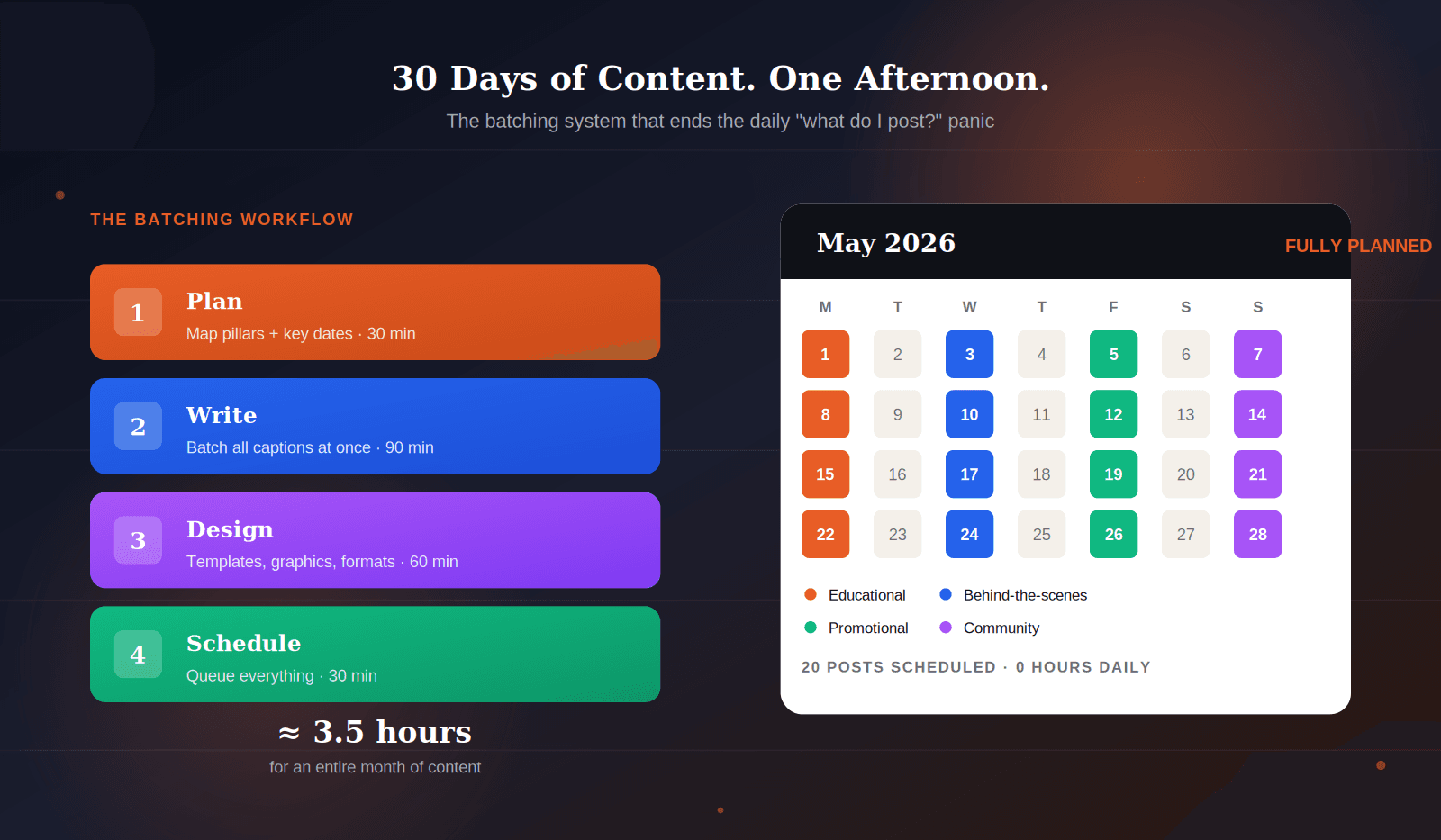
Social Media Content Calendar on Autopilot: 30 Days in 30 Minutes
How to generate, schedule, and batch a full month of on-brand posts across Instagram, Facebook, and LinkedIn in one sitting — with a repeatable weekly rhythm you can actually stick to.
Read article
20 Best Blog Examples for 2026: Your Ultimate Guide
Explore 20 top blog examples for 2026, from B2B to lifestyle, and learn what makes them successful.
Read article
Inbound Link Checker: How to Check & Analyze Inbound Links
3 free ways to check inbound links in 5 minutes, plus the 6 metrics that show whether your backlinks help or hurt your rankings. Step-by-step guide.
Read articleReady to rank? Start free today.
Put your SEO on autopilot. No credit card, no installations — ready in 2 minutes.