

You've poured countless hours into your website, but does it truly command respect in the digital landscape? The frustration of creating great content only to see it buried in search results is real. Understanding your website's influence is the first step to claiming your rightful place at the top.
A website authority checker is an SEO tool that evaluates a domain's overall strength and influence in search engine rankings by analyzing various factors, including backlink profiles and content quality. It provides a score, such as Domain Authority (DA) or Domain Rating (DR), to predict how well a website might rank.
- Website authority checkers provide scores like DA and DR to estimate a site's ranking potential.
- These tools analyze backlink profiles, referring domains, and content quality to determine influence.
- Belgian businesses can use authority checkers for competitor analysis and identifying link-building opportunities.
- Improving influence involves creating high-quality content, earning relevant backlinks, and optimizing on-page SEO.
- Authority scores are predictive metrics, not direct ranking factors, and should be part of a broader SEO strategy.
What is a Website Authority Checker and Why Does it Matter?
A website authority checker helps you understand your site's standing in the digital ecosystem. It measures a website's overall strength and influence in search engine rankings, a critical component for SEO in the competitive Belgian market. This assessment goes beyond simple keyword usage, delving into the underlying factors that Google considers when evaluating a site's credibility. For Belgian SMBs, this insight is invaluable for strategic planning.
Defining Website Authority: More Than Just a Number
Website influence isn't a single, official Google metric. Instead, it's a composite score developed by various SEO tool providers to estimate how well a website might rank. It reflects a site's perceived credibility and relevance based on factors like the number and quality of backlinks, the reputation of linking domains, and the overall quality of its content. A higher score generally indicates a stronger website presence, leading to better visibility in search results.
Key Metrics: DA, PA, DR, and Trust Flow Explained
Several key metrics help quantify website influence. Moz's Domain Authority (DA) is a widely recognized metric, scoring websites on a 0-100 scale. A 'good' DA score for a small business in Belgium might range from 20-40, indicating a growing presence and potential for ranking. Page Authority (PA), also from Moz, focuses on the predictive ranking strength of individual pages rather than the entire domain. This distinction is crucial for optimizing specific landing pages or blog posts.
Ahrefs' Domain Rating (DR) offers another perspective, measuring the strength of a website's backlink profile on a 0-100 scale. Meanwhile, Majestic's Trust Flow (TF) assesses the quality of backlinks, indicating how trustworthy a site is based on the quality of sites that link to it. These metrics, while distinct, collectively provide a comprehensive view of a website's strength.
| Metric | Provider | Scale | Focus |
|---|---|---|---|
| Domain Authority | Moz | 0-100 | Overall domain strength and ranking potential |
| Page Authority | Moz | 0-100 | Individual page strength and ranking potential |
| Domain Rating | Ahrefs | 0-100 | Backlink profile strength |
| Trust Flow | Majestic | 0-100 | Quality and trustworthiness of backlinks |
How Website Authority Checkers Work: Tools and Functionality
Website authority checkers simplify the complex process of evaluating a domain's strength. These tools leverage sophisticated algorithms to crawl the web, analyze vast amounts of data, and distill it into an understandable score. Understanding their mechanics empowers you to interpret results accurately and make informed SEO decisions.
Step-by-Step: Using a Free Website Authority Checker
Using a free website authority checker is straightforward. First, navigate to the tool's website, such as Moz's Link Explorer or Ahrefs' Free DR Checker. Input the URL of the website you wish to analyze into the designated search bar. The tool will then process the request and display the relevant authority scores, along with other SEO metrics. For instance, Linkody's Website Authority Checker provides a quick overview of referring domains and top backlinks, which can be useful for a rapid assessment.
Beyond the Score: Analyzing Backlinks and Referring Domains
These tools do much more than just provide a numerical score. They meticulously analyze backlink profiles, examining the quantity and quality of links pointing to a website. This includes identifying referring domains – the unique websites linking to yours – and assessing the relevance and strength of those links. A high number of diverse and relevant links from respected sources significantly boosts a website's perceived strength. Conversely, a high percentage of spam scores or low-quality links can negatively impact influence. Regularly performing an inbound link checker analysis can help identify and disavow harmful links, safeguarding your site's reputation.
Practical rule: Don't just look at the number; investigate the links behind it. A site with a DR of 30 built on 10 high-quality links is often stronger than one with a DR of 40 built on 100 spammy ones. For Belgian businesses, this means focusing on acquiring links from local, reputable sources.
Strategic Uses for Your Belgian Business: Gaining a Competitive Edge
For businesses in Belgium, a website authority checker is a powerful strategic asset. It moves you beyond guesswork, providing data-driven insights to sharpen your SEO strategy and outmaneuver competitors. The goal isn't just to increase your score, but to translate that into tangible Google traffic.
Benchmarking Against Belgian Competitors
One of the most effective uses of these tools is for competitive website analysis. By inputting your competitors' URLs, you can compare your website's influence scores, backlink profiles, and top-ranking keywords. This allows you to identify content gaps and understand what's working for others in your niche. For example, if a competitor has a significantly higher DR, examining their backlink sources can reveal untapped link-building opportunities. According to a 2024 survey by Statista, approximately 65% of Belgian SMBs actively use SEO tools for competitive analysis, highlighting its importance.
| Website | DA Score | Referring Domains | Top Keywords |
|---|---|---|---|
| Your Business | 32 | 150 | "Belgian chocolate delivery", "Brussels tour guide" |
| Competitor A | 48 | 280 | "Best Belgian beers", "Flemish art galleries" |
| Competitor B | 39 | 200 | "Antwerp diamond district", "Belgian waffle recipe" |
Identifying High-Quality Link Building Opportunities
Website authority checkers are indispensable for identifying promising link-building prospects. When evaluating potential partners for guest posting or content collaborations, checking their DA or DR ensures you're pursuing links from sites that will genuinely enhance your own. A study by Semrush in 2025 indicated a strong correlation between higher website influence and increased organic traffic, with sites above DA 50 seeing an average of 3x more traffic than those below DA 20. When you check backlinks, look for sites with strong, relevant profiles. This ensures your efforts contribute positively to your site's strength, rather than attracting low-quality links that could harm your SEO. Monitoring your own site's influence growth over time helps validate your SEO efforts and adjust your strategy as needed in 2026.
Boosting Your Website Authority: Actionable Strategies for SMBs
Increasing your website's influence is a long-term play, but it's achievable with consistent, strategic effort. For small to medium businesses (SMBs) in Belgium, focusing on quality content and targeted outreach can yield significant results, driving measurable improvements in your domain authority score.
Content is King: Creating Authoritative & Relevant Content
The foundation of strong website influence is high-quality, relevant content. For Belgian businesses, this means creating in-depth guides on local topics, original research pertaining to the Belgian market, or localized content that resonates with your target audience. Think about answering common questions, solving local problems, or providing unique insights that establish your site as a go-to resource. For example, a local bakery could publish a comprehensive guide to traditional Belgian pastries, attracting both local and tourist traffic. This kind of valuable content naturally attracts backlinks and improves your site's reputation.
Building a Strong Backlink Profile: Quality Over Quantity
Earning high-quality backlinks from respected and relevant websites is paramount. Focus on quality over quantity. Tactics include broken link building, where you find broken links on relevant sites and offer your content as a replacement. Resource page outreach involves identifying pages that list useful resources in your niche and proposing your content for inclusion. Engaging with local businesses or industry associations for partnerships and co-marketing can also generate valuable links. Remember, a backlink from a highly relevant Belgian news site or industry blog carries more weight than dozens from obscure, unrelated sources.
Improving on-page SEO factors, such as optimizing meta descriptions, ensuring fast page load speeds, and structuring your content with clear headings, also contributes indirectly to perceived influence. A well-structured site with excellent user experience (UX) encourages longer visits and lower bounce rates, signals that Google interprets positively. While social signals and brand mentions aren't direct ranking factors for DA or DR, they enhance overall website visibility and reputation, which can indirectly lead to more organic links and improved site strength.
Common Misconceptions and Advanced Insights for Authority Metrics
Understanding website influence goes beyond simply knowing your score. It involves grasping the nuances of these metrics and how they fit into a broader SEO strategy. Avoid common pitfalls by debunking myths and leveraging advanced insights, especially with the rise of AI in content generation.
Debunking Myths: Authority Scores Aren't Everything
It's crucial to clarify that website authority scores are predictive metrics, not direct ranking factors used by Google. They estimate how well a site might perform in search results based on various signals, but Google's algorithm uses hundreds of factors. A low DA or DR isn't a death sentence for new websites; rather, it's a starting point for growth. Focus on a holistic SEO strategy, including exceptional content, technical SEO, and user experience, rather than fixating solely on the number. A site with a DA of 20 can still outrank a DA 40 site for specific, niche keywords if its content is more relevant and well-optimized.
The Role of AI in Authority Analysis and Content Generation
AI-powered platforms are transforming how businesses approach website influence. Tools like BoltSEO can analyze competitor influence and identify content gaps with remarkable efficiency. This allows for automated content generation that is highly relevant and designed to fill those gaps, specifically mentioning how an AI platform can help create authoritative articles. BoltSEO learns your business from your own website, writes SEO articles a reader would swear you wrote, and publishes them to WordPress, Shopify or Webflow. This means Google traffic, without the content team.
AI can assist in identifying high-influence topics and optimizing content for both relevance and depth. By leveraging AI for keyword research and content outlines, businesses can produce articles that are more likely to attract high-quality backlinks and improve their site's overall strength. This allows you to scale your content efforts, ensuring a consistent flow of valuable, optimized articles that indirectly boost your site's position. Five minutes of setup. Then it runs.
Frequently asked questions
What is a good website authority score?
A "good" website authority score is relative and depends on your industry and competition. For small to medium businesses, a Domain Authority (DA) or Domain Rating (DR) between 20-40 is generally considered a solid foundation, indicating growing influence and potential. Higher scores, typically above 50, are common for established brands and larger enterprises.
How often should I check my website's authority?
You should check your website's authority regularly, ideally monthly or quarterly. This allows you to monitor trends, assess the impact of your SEO efforts, and stay aware of competitor movements. Consistent monitoring helps you adapt your strategy to maintain and improve your site's strength over time.
Can a new website have high authority?
It is challenging for a new website to have high authority immediately, as these scores are built over time through consistent content creation and backlink acquisition. However, a new site can rapidly build influence by publishing exceptional content, securing high-quality backlinks from relevant sources, and ensuring strong technical SEO from day one.
What is the difference between Domain Authority and Page Authority?
Domain Authority (DA) measures the overall predictive ranking strength of an entire domain or website, while Page Authority (PA) measures the predictive ranking strength of a specific individual page on that domain. Both are Moz metrics, but DA gives a broad overview, and PA offers granular insight into single-page performance.
Does website authority directly impact Google rankings?
No, website authority scores like DA and DR are not direct ranking factors used by Google. They are third-party metrics that estimate a website's potential to rank based on various factors, primarily its backlink profile. Google uses its own proprietary algorithms and hundreds of signals to determine search rankings.
Keep reading
More on SEO, GEO and growing your organic traffic.
Keyword Clustering: The SMB's Guide to Smarter SEO
Keyword clustering groups related keywords to boost organic traffic and streamline your SMB's content. Learn how to rank higher. Start free.
Read article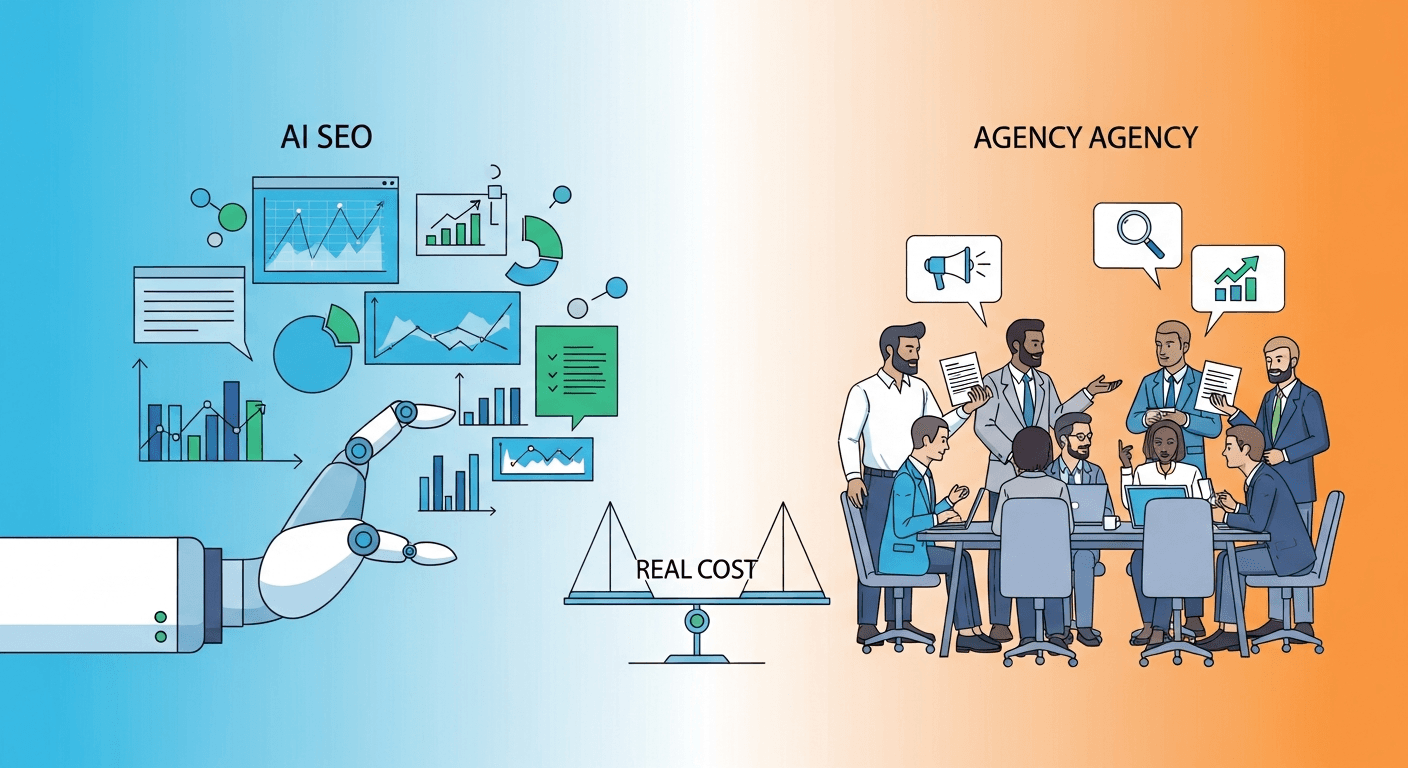
AI SEO vs. an SEO Agency: The Real Cost for SMBs
AI SEO or an SEO agency? An honest cost, time, and results comparison for small businesses in 2026 — what each really delivers, and which fits a tight budget.
Read article
Free SEO Audit: How to Check Your Website in 5 Minutes
Run a free SEO audit on your website in 5 minutes. The 7 things to check, what each score means, and how to fix the most common issues.
Read articleReady to rank? Start free today.
Put your SEO on autopilot. No credit card, no installations — ready in 2 minutes.