
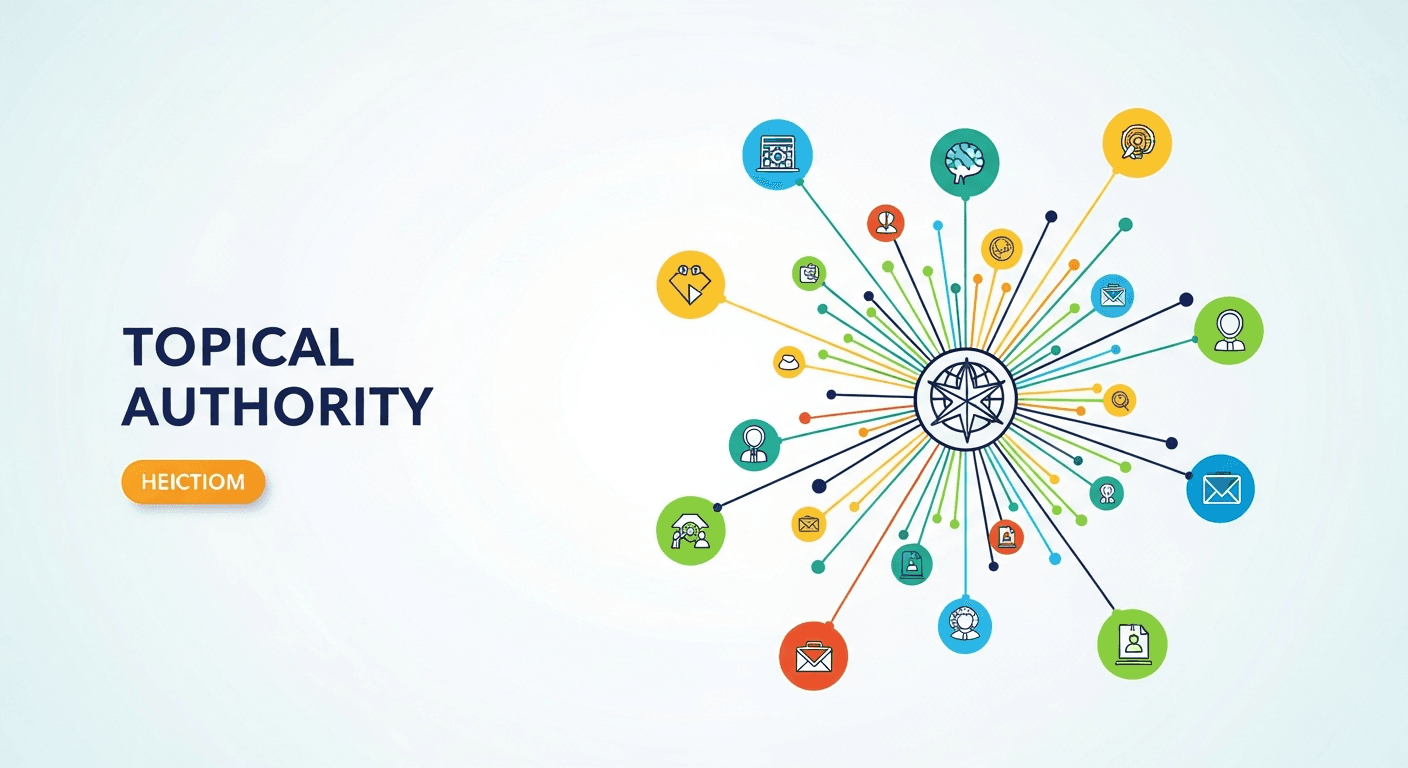
Topical authority is when search engines recognize your website as a comprehensive and trusted expert source on a specific subject, not just for individual keywords. It signals to Google that your site offers deep, broad, and reliable information, leading to higher rankings for a wide range of related queries. This strategic approach moves beyond chasing individual keywords. Instead, it aims to establish your brand as the go-to resource. For small to medium businesses (SMBs), this can be a game-changer.
- Topical authority establishes your site as a trusted expert on a subject, crucial for higher Google rankings.
- Build it using 'The Topic Cluster Blueprint': a central pillar page supported by interconnected cluster content.
- Strategic content creation involves in-depth research, diverse formats, and leveraging AI for efficiency.
- Measure progress by tracking keyword rankings, organic traffic, and analyzing internal linking and content gaps.
- Avoid thin content and regularly update your articles to maintain and grow your topical authority.
What is Topical Authority and Why Does it Matter for Your Business?
Topical authority marks your website as a definitive expert on a specific subject. This goes beyond traditional keyword stuffing or simply accumulating backlinks. Google's algorithms now prioritize sites that demonstrate genuine expertise. This shift helps users find the most reliable information.
Beyond Keywords: Understanding Google's E-E-A-T
Google's focus has evolved significantly. Its E-E-A-T guidelines — Experience, Expertise, Authoritativeness, and Trustworthiness — are crucial. Topical authority aligns perfectly with these principles. It proves your site offers a holistic understanding of a subject. This is far more valuable than optimizing for isolated search terms. According to Google's Helpful Content Guidelines, content should be created primarily for people, not search engines.
The Direct Impact of Topical Authority on SEO Rankings
Websites with strong topical authority can achieve significantly higher organic traffic and keyword rankings compared to those without. For instance, a local plumbing business focusing on "emergency pipe repair" can rank for "burst pipe solutions," "leak detection tips," and "winter pipe maintenance." This happens by comprehensively covering all sub-topics. It signals deep knowledge. Search Engine Optimization on Wikipedia notes that modern SEO emphasizes content quality and relevance. This comprehensive approach helps SMBs compete effectively. They can dominate specific niches, even against larger, more general competitors.
The Core Framework: Building Topical Authority with Content Clusters
Building topical authority requires a structured approach. 'The Topic Cluster Blueprint' offers a powerful framework for this. It organizes your content strategically. This method ensures comprehensive coverage of your chosen subjects.
Identifying Your Niche: The Foundation of Authority
The first step involves identifying 3-5 core topics for your business. These should directly relate to your services or products. Choose topics with sufficient search volume and clear business value. For an SMB selling eco-friendly cleaning supplies, "sustainable home cleaning" could be a strong niche. It allows for deep exploration.
Pillar Pages: Your Topic's Central Hub
A pillar page serves as the ultimate resource for a broad topic. It provides a high-level overview. All related sub-topics branch out from this central piece. A pillar page for "sustainable home cleaning" might be titled "The Ultimate Guide to Eco-Friendly Home Cleaning in 2026." Its structure would include sections on non-toxic ingredients, DIY recipes, and product comparisons.
Cluster Content: Supporting Your Pillar with Depth
Cluster content comprises individual articles that delve into specific aspects of the pillar topic. Each cluster article links back to the pillar page. They also link to other relevant cluster articles. This creates a robust internal linking structure. Implementing a topic cluster strategy can lead to a measurable increase in website visibility and search engine trust within 6-12 months. This interconnectedness boosts the overall topical authority of your site.
| Content Type | Purpose | Example Title |
|---|---|---|
| Pillar Page | Comprehensive overview, central hub for a broad topic | The Ultimate Guide to Eco-Friendly Home Cleaning |
| Cluster Content 1 | Deep dive into a specific sub-topic, supports the pillar | 5 Natural Ingredients for a Chemical-Free Home |
| Cluster Content 2 | Addresses a specific question, links to pillar and other clusters | How to Make Your Own DIY All-Purpose Cleaner |
Strategic Content Creation for Topical Dominance
Effective content creation is the engine of topical authority. It demands thorough research and diverse formats. Leveraging modern tools significantly streamlines this process.
In-Depth Research: Uncovering Every Angle of Your Topic
Thorough research is non-negotiable. Use competitor analysis to identify gaps in existing content. Explore 'People Also Ask' sections on Google for common user questions. Keyword tools like Semrush or Ahrefs reveal related search terms and user intent. Aim to cover 10-15 relevant sub-topics within each cluster. This ensures comprehensive topical authority seo.
Content Formats That Build Authority
Varying your content formats keeps readers engaged and addresses different search intent. Use ultimate guides for pillar pages. Case studies demonstrate real-world results and build trust. Comparison articles help users make informed decisions. How-to tutorials solve specific problems. For example, a "sustainable home cleaning" pillar page could be a comprehensive guide. Cluster content might include a case study on a family transitioning to eco-friendly products.
Leveraging AI for Efficient Topical Content Generation
AI-powered content generation tools can reduce the time spent on content creation for topic clusters by a substantial percentage. Platforms like BoltSEO automate many labor-intensive tasks. They can generate outlines, create first drafts, and optimize content for SEO. This frees up human writers for strategic oversight and refinement. BoltSEO's AI Marketing Automation for Small Businesses capabilities can save 70-80% of manual effort. This allows SMBs to scale their content efforts rapidly.
Measuring and Monitoring Your Topical Authority Progress
Tracking your progress is essential. It ensures your efforts are yielding results. Consistent monitoring allows for timely adjustments and further optimization.
Tracking Keyword Rankings and Organic Traffic
Monitor keyword rankings for both your pillar and cluster content. Look for improvements across a broad range of related terms. A healthy increase is 20-30% in organic traffic to topic cluster pages over 3-6 months. Use tools like Google Search Console to track impressions and click-through rates. This helps identify high-performing content and areas needing improvement.
Analyzing Internal Linking and Content Gaps
Regularly audit your internal linking structure. Ensure all cluster content links back to its pillar page. Verify that pillar pages link to relevant cluster articles. This reinforces the topic cluster blueprint. Identify any content gaps by reviewing user questions and competitor content. Fill these gaps with new articles to achieve more complete topic coverage. This boosts your topical authority meaning.
Tools to Assess Your Topical Authority Score
Several SEO tools offer metrics to gauge your topical authority. Google Search Console provides free, essential data on organic performance. Semrush offers comprehensive keyword position tracking and topic coverage reports. Ahrefs excels at competitive analysis and backlink monitoring. Each tool provides valuable insights into your progress.
| Tool | Key Metric for TA | Benefit |
|---|---|---|
| Google Search Console | Impressions, Clicks, Average Position | Identifies search queries, content performance, and ranking trends. |
| Semrush | Keyword Position Distribution, Topic Gap | Reveals ranking improvements, content gaps, and competitor strategies. |
| Ahrefs | Organic Keywords, Content Gap, Site Audit | Tracks keyword growth, uncovers missing topics, and highlights linking issues. |
Common Pitfalls and Best Practices for Sustained Topical Authority
Maintaining topical authority requires vigilance. Avoid common mistakes and adhere to best practices. This ensures long-term success.
Avoiding Thin Content and Keyword Stuffing
A major pitfall is creating too many shallow articles. This is known as "thin content." Such content offers little value. Another mistake is keyword stuffing, which Google penalizes. For instance, a short blog post with only 300 words on "best dog food" and repeated keywords is thin. Instead, create comprehensive articles with 1,000+ words. Focus on user intent and provide genuine insights.
The Importance of Regular Content Updates and Expansion
Content is not a "set it and forget it" asset. Evergreen content should be reviewed annually. Rapidly changing topics might require quarterly updates. Actions include adding new data, expanding sections with more detail, or updating outdated examples. This keeps your content fresh and relevant. It signals to Google that your site is a reliable source of current information.
Integrating User Experience (UX) for Authority Signals
Positive user experience (UX) directly contributes to topical authority. Low bounce rates and high time-on-page signal engagement. Clear navigation helps users find information easily. Elements like clear headings, engaging visuals, and mobile responsiveness are vital. These UX factors improve visitor satisfaction. They also send strong authority signals to search engines. Learn SEO with BoltSEO to understand these connections better.
Frequently asked questions
What is the difference between topical authority and domain authority?
Topical authority focuses on a website's expertise within a specific subject area. Domain authority, a metric developed by Moz, estimates a website's overall ranking strength across all topics. While both are important for SEO, topical authority emphasizes depth of knowledge on particular subjects, contributing to better rankings for related queries.
How long does it take to build topical authority?
Building topical authority is a gradual process. It typically takes 6-12 months to see significant results, depending on your niche, content strategy, and consistency. New websites might take longer, while established sites with a strong content plan can accelerate the process.
Can a new website build topical authority?
Yes, absolutely. A new website can build topical authority by focusing on a narrow, underserved niche and creating exceptionally comprehensive content for it. Starting with a clear 'Topic Cluster Blueprint' and consistent publication will help a new site establish expertise faster.
Is topical authority more important than backlinks?
Topical authority and backlinks are both crucial for SEO, but their roles differ. Topical authority establishes your site as a trusted resource, while backlinks act as votes of confidence from other sites. Many practitioners agree that strong topical authority can reduce the reliance on a massive backlink profile, especially for niche topics.
How does Google measure topical authority?
Google measures topical authority by analyzing the breadth, depth, and interconnectedness of your content on a specific subject. It looks at how thoroughly you cover all facets of a topic, the quality of your information, and how well your internal linking structure supports the user journey.
What are topic clusters in relation to topical authority?
Topic clusters are the organizational framework for building topical authority. They consist of a central, comprehensive pillar page and several supporting cluster articles. This structure helps search engines understand the relationships between your content pieces and recognize your site's expertise on the overarching topic.
Can I build topical authority for multiple topics?
Yes, you can build topical authority for multiple topics. However, it is best to focus on one topic cluster at a time until you establish strong authority in that area. Once you've dominated one niche, you can then strategically expand to related topics, leveraging your existing credibility.
Keep reading
More on SEO, GEO and growing your organic traffic.
Keyword Cannibalization: Identify, Fix, and Prevent It
Don't let keyword cannibalization hurt your SEO. Learn to identify, fix, and prevent this common issue to boost your website's search performance today!
Read articleSmall businesses hold a quarter of Google's page one (but not in retail)
We checked who actually ranks on page one for 5,953 small-business searches in six European markets. Small businesses hold about a quarter of the places, but the sector matters far more than keyword difficulty.
Read article
Generative Engine Optimization Tools: Your 2026 UK Guide
The top generative engine optimization (GEO) tools for UK businesses in 2026, and how to use them to get found in AI search answers.
Read articleReady to rank? Start free today.
Put your SEO on autopilot. No credit card, no installations — ready in 2 minutes.